Deep in the Mountains of Yunnan, China’s Best Ham Stays Hidden
In the early autumn of 2023, I traveled to Southwest China’s Yunnan province — neither for the legendary Shangri-la nor the laid-back Dali — but for a type of ham that had until recently been clouded in obscurity.
The village of Nuodeng, a collection of traditional houses nestled on steep slopes, operates on the quiet rhythm of the mountains. For centuries, life here revolved around a 21-meter-deep brine well, from which highly saline water was drawn, making Nuodeng a bustling hub on the Southern Silk Road, between the former Chinese capital Chang’an, where Xi’an now stands, and present-day India. Mule caravans wound through its narrow alleys, carrying salt cakes to distant lands.
That well is now a museum. But nowadays, brine from nearby wells is still distilled into salt, which is then used in the yearslong process of curing ham. That ham — a ham so exceptional it is the only naturally dry-cured variety in China deemed suitable to eat raw — was what I had come to find.
On my first day, I met Li Xiaofeng, a preeminent Yunnan ham expert, who led me to a small roadside eatery before we ascended into the mountains. As we waited, he placed a plate of thin-sliced ham before me. It was pale pink with intricate marbling, glistening with fat. When I bit into it, the ham almost melted on the tongue. The salt was gentle, giving way to a burst of nutty depth and a refreshing finish that lingered like a breeze.
It was not the heavy, salty cured ham from elsewhere in China, mostly used to give dishes an extra bit of flavor. “Top-tier ham is not meant to be cooked,” Li said.
This moment highlighted a profound divide between Eastern and Western approaches to charcuterie. In China, cured ham has long been a kitchen essential, a flavor booster rather than a standalone delicacy. In contrast, Western traditions have long celebrated dry-cured ham as a centerpiece. Spain’s Ibérico, Italy’s Parma, and France’s Bayonne are revered worldwide, served paper-thin and unadulterated.
Western varieties have long dominated the premium raw-cured market, while even within China, few knew that such a quality product existed in a remote Yunnan village. Most assumed that Chinese pigs — bred for a compact, “spherical” build — lacked the leg structure and fat profile necessary for raw curing. Nuodeng ham shatters this stereotype. The local black pigs have sturdy, muscular legs built for climbing slopes, and their meat, with a perfect 3:7 fat-to-lean ratio, is uniquely suited to slow, natural fermentation.
The story of Nuodeng ham is inseparable from its extraordinary terroir. Tradition dates back over a thousand years, when salt was the region’s lifeblood. For centuries, families from the local Bai ethnic minority have passed down the art of curing, with artisans producing hams for their own tables and for travelers on the Southern Silk Road. Today, the craft is preserved by a small group of dedicated makers led by Li.
What makes Nuodeng ham unique is the confluence of altitude, microclimate, and its legendary natural, unrefined salt — creamy-yellow, mineral-rich, iodine-free, and made by boiling brine from the village’s ancient wells. Unlike industrial salt, which can overpower meat, Nuodeng salt enhances it, drawing out sweetness and umami. Most remarkably, traditional Nuodeng ham contains no detectable nitrites, a common meat additive used to inhibit harmful microorganisms. Instead, a bacteria present in the local salt achieves the same effect.
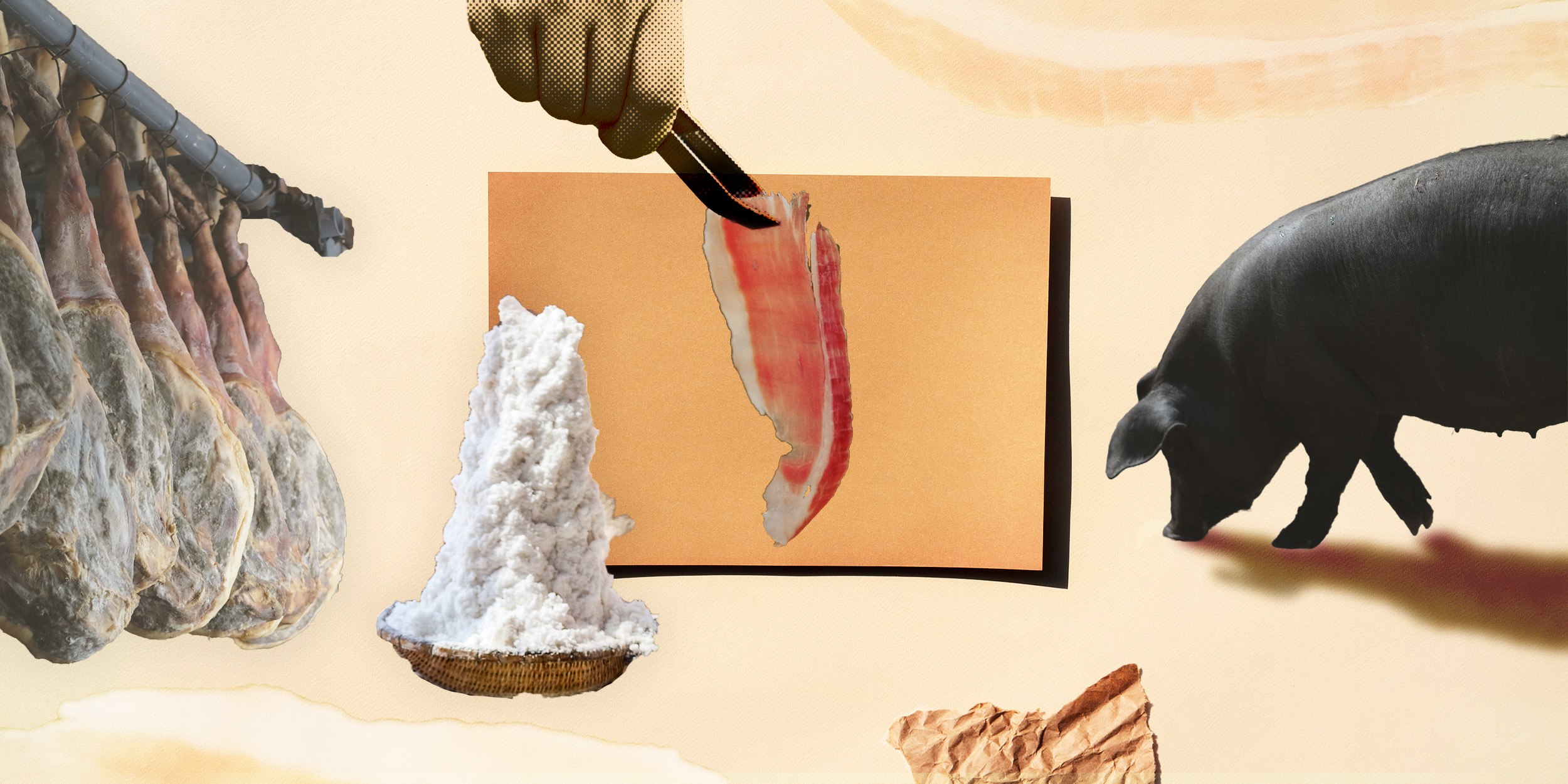
Curing begins after Lidong (the start of winter), when the weather turns cold. Farmers select the largest hind legs — about 15 kilograms each — from black, approximately year-old pigs. The pork legs are first salted for about a month. Then the hams are hung in open-air drying sheds for at least a year, and at least three years if they are to be eaten raw.
Nuodeng’s high altitude, coupled with its cool, dry winters and significant day-night temperature fluctuations, creates an ideal environment for fermentation. Low temperatures inhibit harmful bacteria, while the free-flowing air allows the meat to dehydrate slowly, concentrating its flavors. The daily shift from warm sunlight to freezing nights causes the fat and muscle to contract and expand, forming textures reminiscent of Japanese Wagyu.
Unlike European hams aged in temperature-controlled cellars, Nuodeng ham undergoes a semi-dry, natural fermentation, exposed to the valley’s winds and temperature swings. This results in a product that is slightly firmer than its European counterparts, with a cleaner, non-greasy finish.
Nuodeng ham became a delicacy known throughout the country after it was featured on “A Bite of China,” the hit documentary series by state broadcaster CCTV, in 2012. Nuodeng’s artisans went from obscurity to suddenly having millions of potential customers.
Its prestige grew further when, in 2016, Li led a team to a blind tasting event in Shanghai. It pitted Nuodeng ham against some of the world’s most celebrated varieties, including top-tier Ibérico. Local food critics and consumers tasted the hams without wine — a true test of pure flavor. Nuodeng ham beat the competition. The victory proved that Chinese raw-cured ham could hold its own against the best. Critics specifically noted its delicate rose aroma, creamy texture, and clean aftertaste.
But despite its quality and popularity, bringing Nuodeng ham “down the mountain” remains a challenge. Cured legs are fragile and require careful handling, and the ham is sensitive to environmental changes; even a short distance from the village can alter its flavor.
In recent years, however, things have begun to change. Chefs like Liu Xin, owner of the renowned Shanghai restaurant Hong 0871, have built climate-controlled aging rooms to replicate Nuodeng’s conditions. “You can copy the temperature and humidity,” he notes, “but you can’t copy the wind, the sunlight, or the unique microorganisms of Nuodeng.”
The rise of Nuodeng ham also highlights the tension between capital and small-scale production. As demand grows, large companies are eyeing the market, seeking to mass-produce Nuodeng-style ham. However, traditional curing is a slow, labor-intensive process that cannot be rushed. A top-tier ham takes at least three years to make, and cutting corners results in an inferior product. For small-scale artisans, this poses a threat to their craftsmanship. Yet, Nuodeng ham has proven resistant to industrialization. The pigs still roam free, and the curing still takes place in small workshops.
For me, Nuodeng ham is more than food; it is a connection to a place, a people, and a way of life. On rainy afternoons in Shanghai, I make a salad of thin slices tossed with bitter greens, mulberries, and a drizzle of balsamic. It transports me back to those misty mountains and the realization of the world of flavor I had been missing. In colder months, I serve it with eggs and vegetables, its richness wrapping around me like a blanket.
As I write this, a slice of Nuodeng ham sits on a plate beside me, its rose aroma wafting through the air. It is a taste of salt, wind, and time, of a village that has kept a secret for a thousand years. As more people discover it, Nuodeng ham will take its rightful place among the world’s greatest cured meats, one slice at a time.
(Header image: Visuals from Wang Huimin and VCG, reedited by Sixth Tone)